

How To Draw A Person Walking
Today we will prove you how to draw or animate the human figure walking or running. This drawing lesson is perfect for the person who wants to make an blitheness of a person walking or running…or for the creative person who needs references of walking figures. This tutorial is taken from a book from E.One thousand. Lutz..he was the master of blitheness before the use of computers.
How to Draw and Animate the Homo Figure Walking or Running – Huge Guide and Tutorial
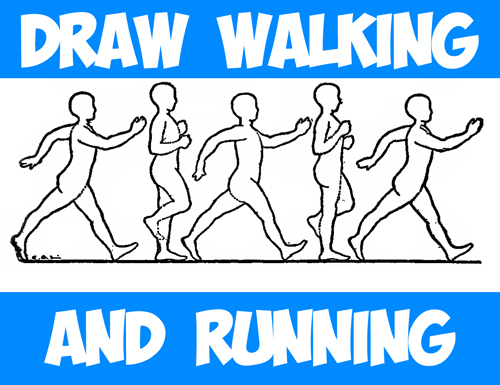
If you desire to learn how to animate, one of the first things you lot will need to larn how to draw is the animated walk. You lot must become skilled in this before mastering running. The move of the limbs and torso give the appearance of walking, and y'all must get information technology just correct to form that illusion. The movement of the lower limbs affects the torso equally well every bit the arms. The arms and shoulders swing is rhythm with the legs to maintain the equilibrium of the person. When you, as an artist, understand the basic facts of the move of the human figure, you lot will and so exist ready to sympathize the movement of animals as well.
To start, we are just going to focus on the motility of the legs. Imagine at present that the person you are drawing is walking. The body in the air, about 30 inches above the ground, is moving forwards. Fastened to this effigy are the legs, alternately swinging and supporting the body in its position above the footing. Farther to simplify our study, we will, at first, consider the mechanism of one limb only.
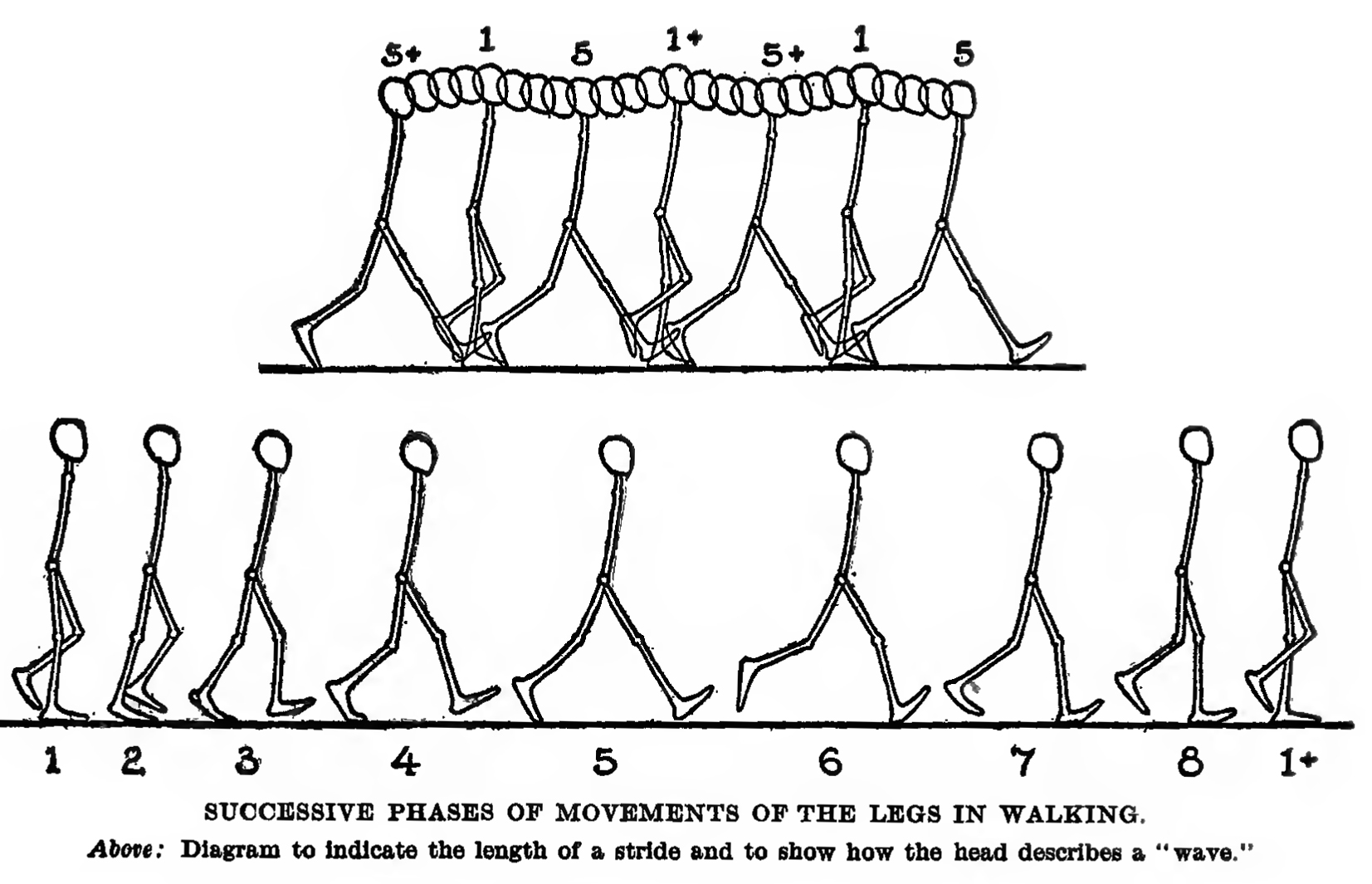
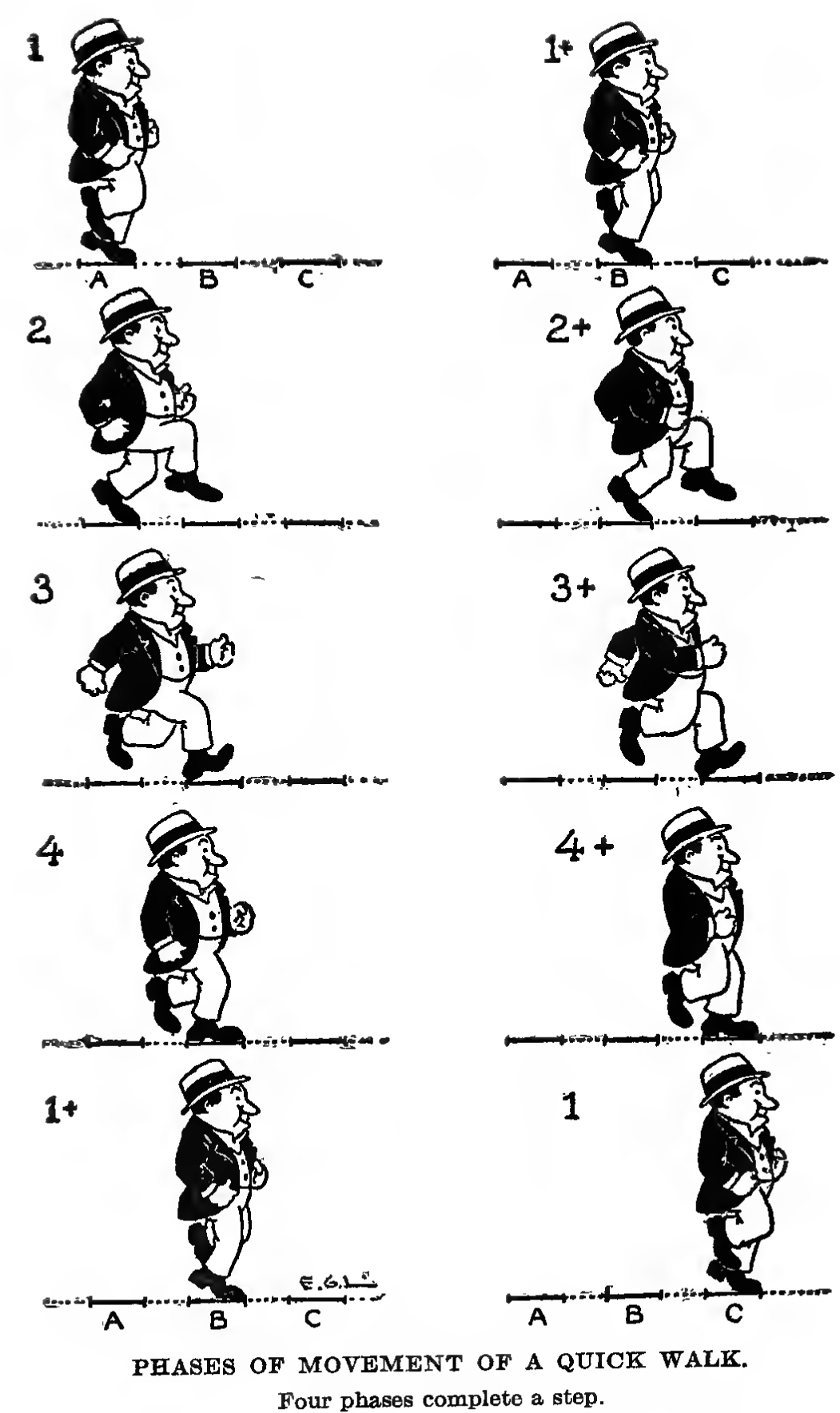
one foot swings forrad and reaches a certain identify, it seems to hesitate for an instant and and then comes down, heel kickoff, on the ground. As the heel strikes, the trunk is slightly jarred and the oblique line of the limb, its axis, moves and approaches the vertical. In a moment, the limb is vertical as its supports the torso and the sole of the foot bears on the ground. Then the axis of the leg changes its vertical-ness and leans forrad, carrying with information technology the body. Before long the heel leaves the ground and but the fore role of the pes-the region of the toes-remains on the footing. But before the foot is entirely lifted from the footing, there is a slight break, almost immeasurable, coming immediately earlier the foot gives a button, leaves the footing, and projects the body forward.
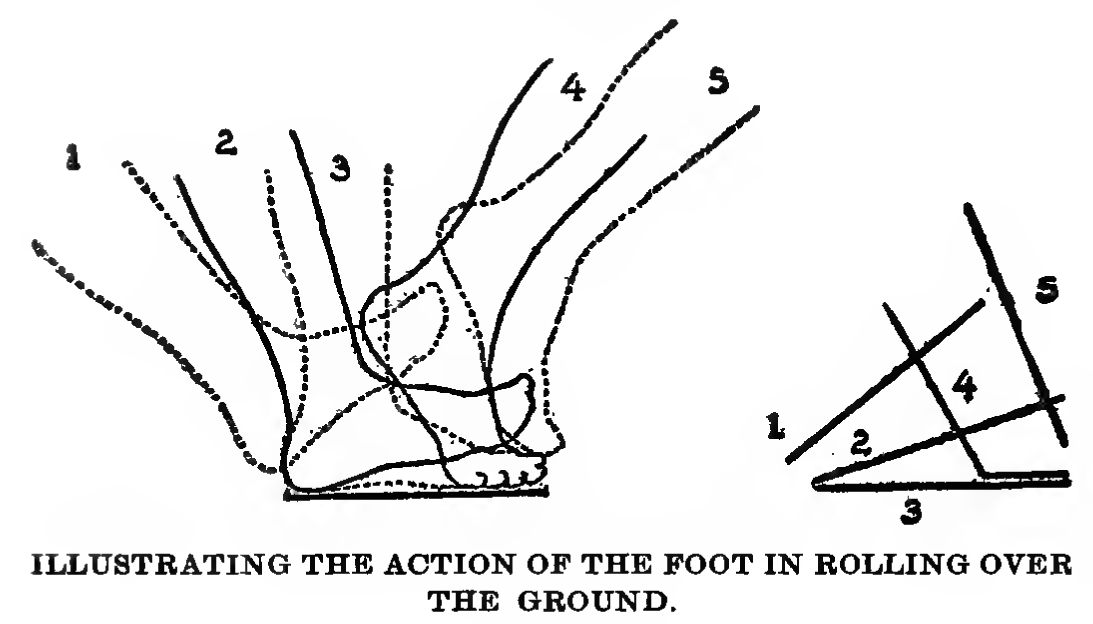
During the time of the phases of move described above, the pes, in a sort of way, rolls over the ground from heel to toes. Immediately after the toes go out the ground, the genu bends slightly and the limb swings pendulum-similar forward, then, as it nears the bespeak directly nether the center of the body, it bends a fiddling more and lifts the pes to clear the ground. After the limb has passed this central point under the body and is beginning to advance, it straightens out prepare to plant its heel on the ground once again. When information technology has done and then it
has completed the step, and the limb repeats the serial of motion phases again for the next stride.
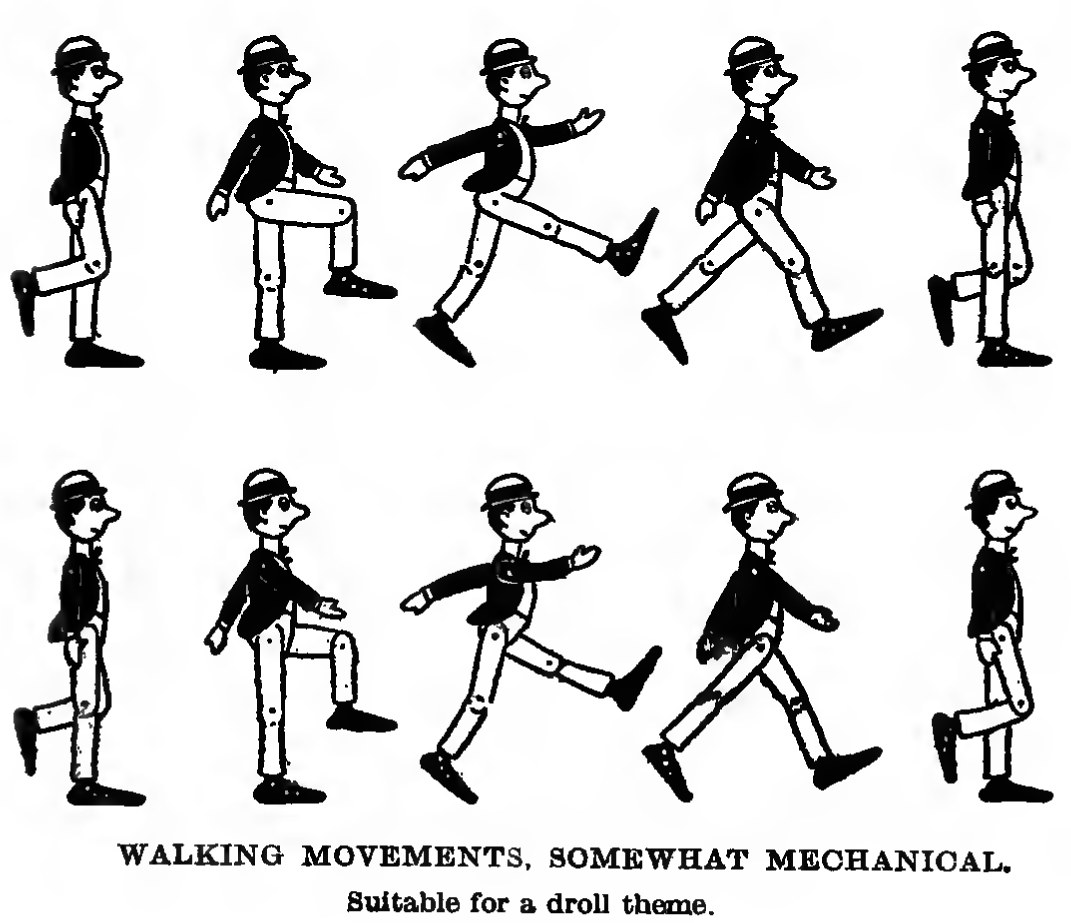
Now, the limb of the other side has gone through the same movements, too, merely the corresponding phases occurred alternately in signal of time. 1 of these positions of the leg, that when it is aptitude at the articulatio genus so every bit to clear the ground as it passes from the back to its advancing movement forward, is rarely represented past the graphic creative person in his pictures. The aspect of the limbs when they are at their extremes-spread out one
forward and one to the back, is his usual. pictorial symbol for walking. Merely the position, immediately noted higher up, is an important phase of movement, as information technology is during its continuance that the other limb is supporting the trunk.
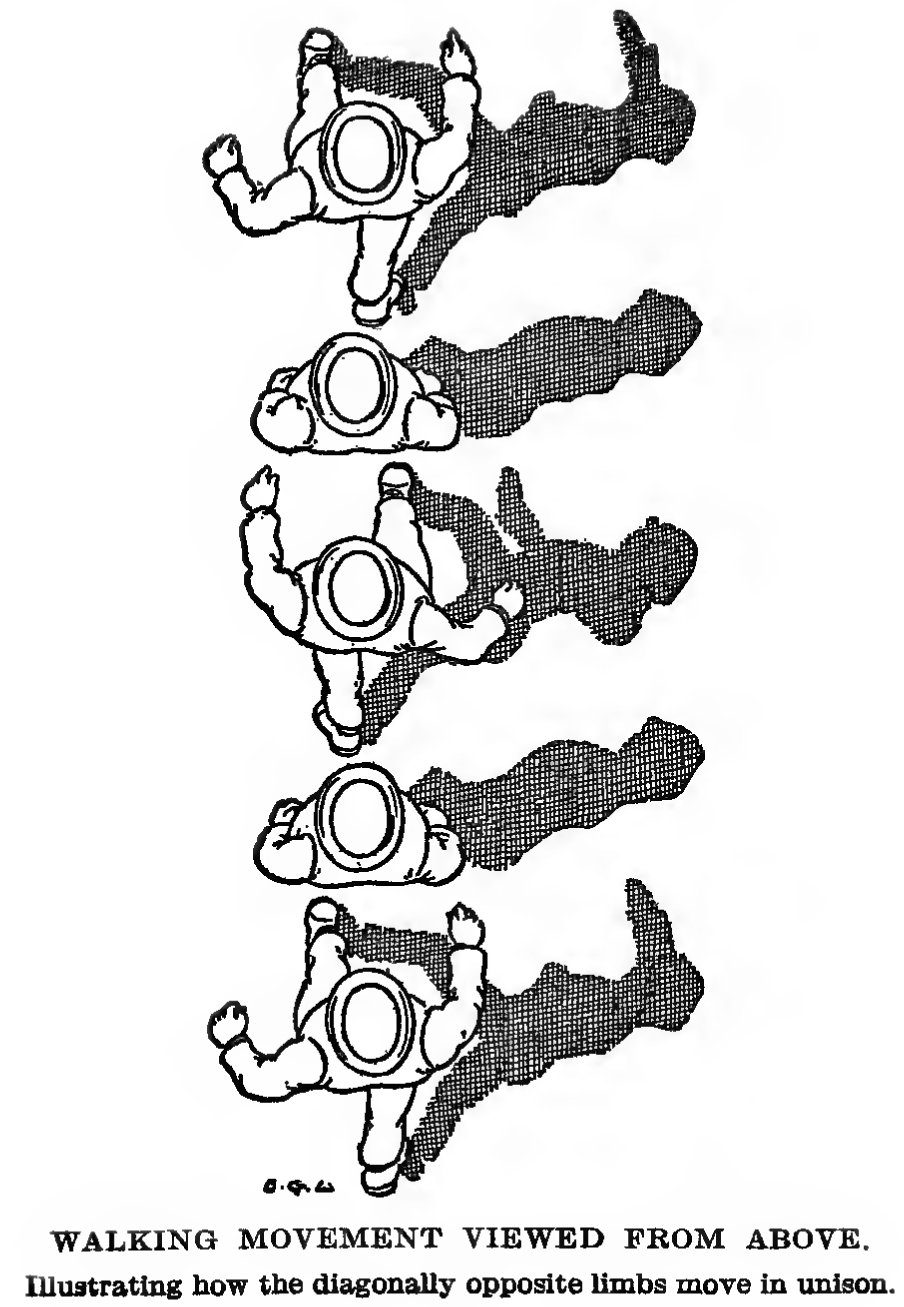
A motility of the body in walking can be seen turning from side to side as it swings in rhythm with the upper limbs while they alternately swing forward and backward. It is a movement that animators do non e'er
think virtually, since only an accomplished animator can imagine movement clearly enough to recreate information technology. To describe the movement improve we will consider it visually.
We are looking at the walker from the side now and tin see the body in profile-exactly in profile. When the walker'south artillery are at the middle position. As the virtually-side arm moves forward we run into a slight three-quarter back view of the upper part of the trunk / torso, and then when the arm swings dorsum nosotros meet the contour again, and with the arm moving still further back, the corresponding side of the shoulder moves with it and the upper part of
(ane) A three-quarter view from the front;
(2) contour;
(iii) a iii-quarter view from the dorsum, and then carries them dorsum and forth
It gives to person, when slightly exaggerated in a funny cartoon picture, a very funny swaggering gait.
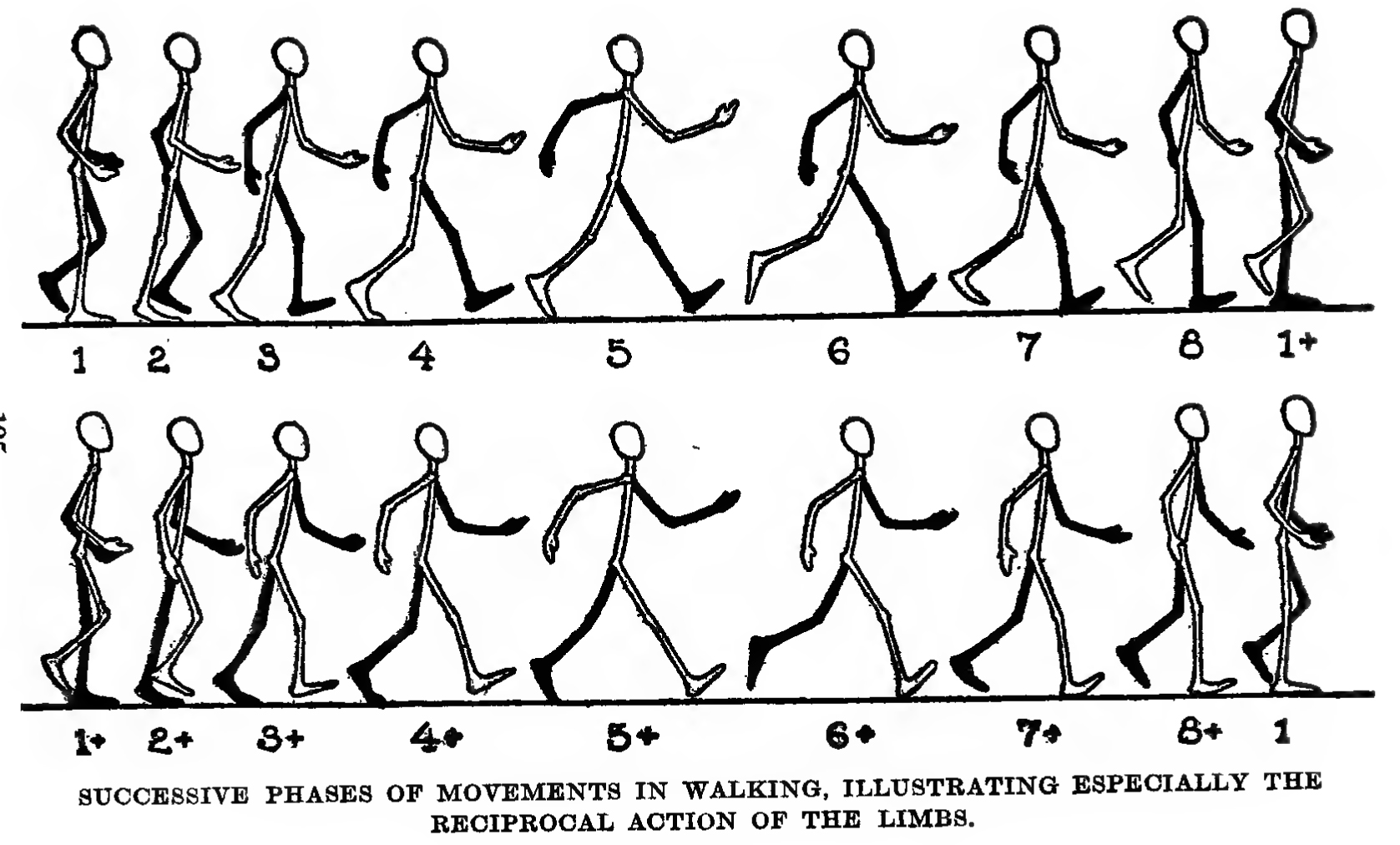
The arms were mentioned every bit swinging in a walk and so as to assist maintain the person's equilibrium.I don't recollect you volition have a difficult fourth dimension understanding the phases through which they go if you just remembered that an arm moves in unison with the lower limb of the reverse side. This can be seen if yous go and expect from an upper window down at walkers that are passing by. I desire to note that one arm as it hinges and oscillates from the shoulder-joint, follows the lower limb of the contrary side every bit it hinges and swings from the hip-articulation.
Contemplating the artillery only, it will be seen that they go along up a constant alternate swinging back and forth. The signal where they pass each other will exist when they both have approached their respective sides of the torso. This item moment when the arms are opposite one some other and close to the trunk, or at least
about the vertical line of the trunk, is coincident with the phases of the lower limb movements when one is nearly rigid as it supports the trunk and the other is at its median phase of the swinging movement.
These centre positions of the four limbs-the lower near to each other, and the upper close to the body-is a characteristic that yous should take notation of and remember. This is a sort of opening motion following past a closing i. These reciprocal changes, expansion and retractions in people and animals, symbolize the activeness
of life.
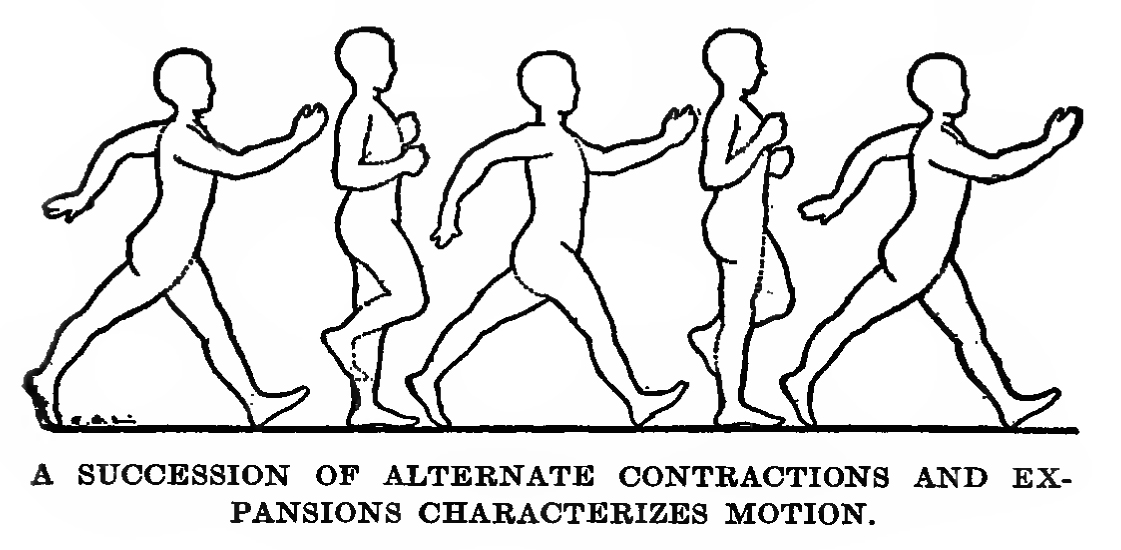
In the human body, for example, during action, there are certain times when the limbs are close to the torso and at other times when they are stretched out or extended. This is can be manifestly seen in the jumping figure. Specifically, this tin be seen in the position of the person before the actual leap, the appendicular members bend and lie shut to the trunk. The entire trunk is compact and repressed like a spring. Then when the jump takes place, there is a sudden opening every bit the limbs flinging themselves outward.
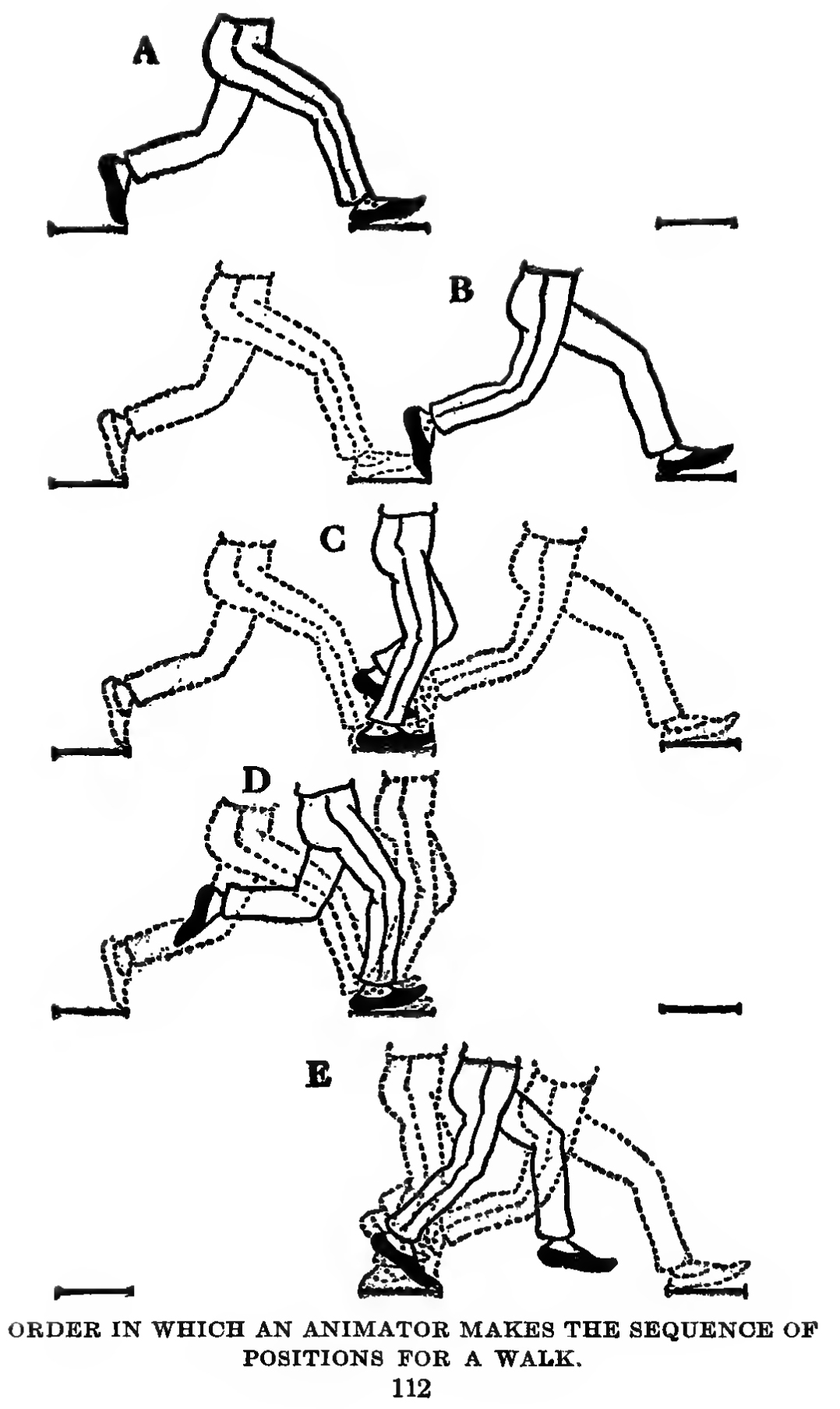
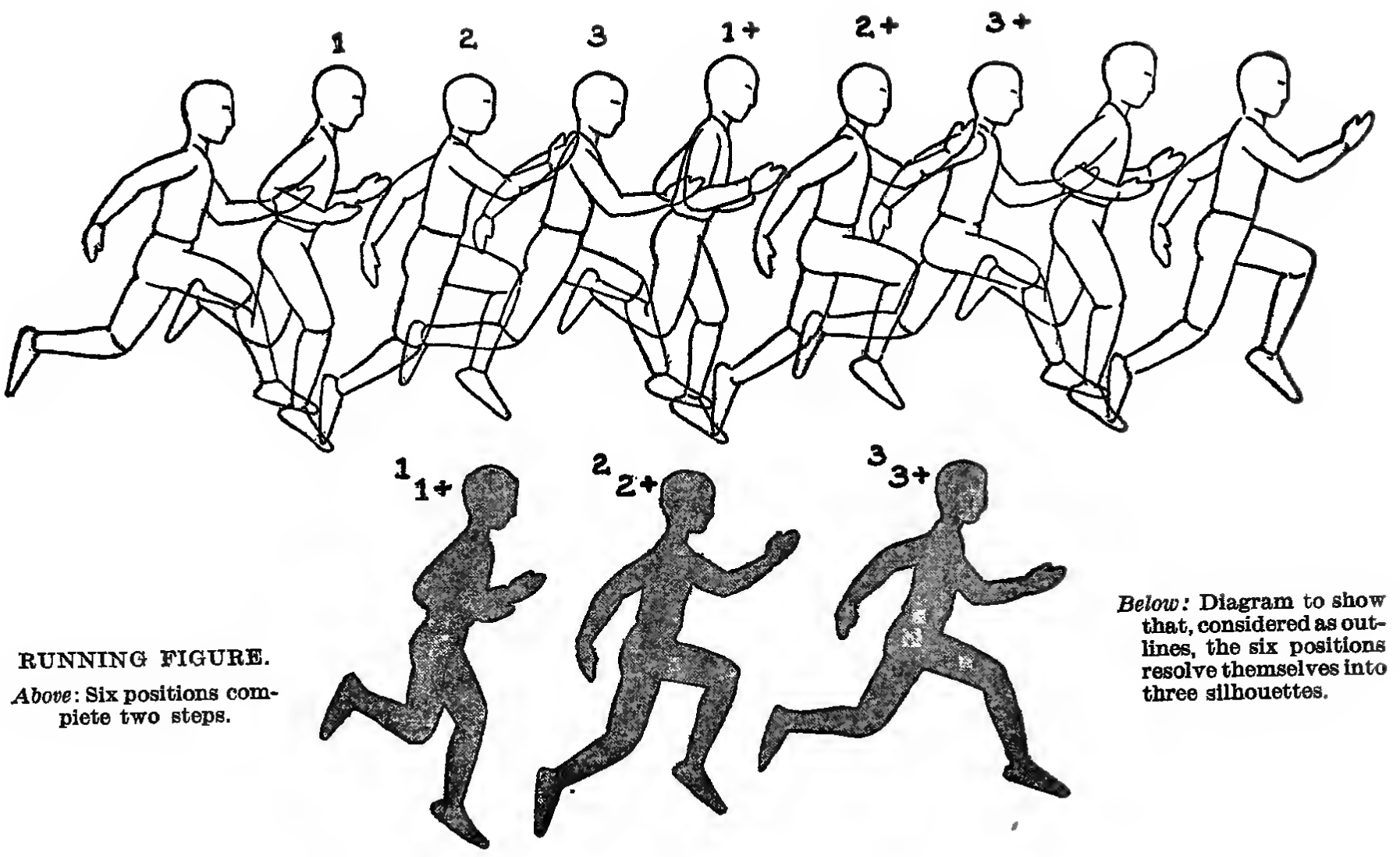
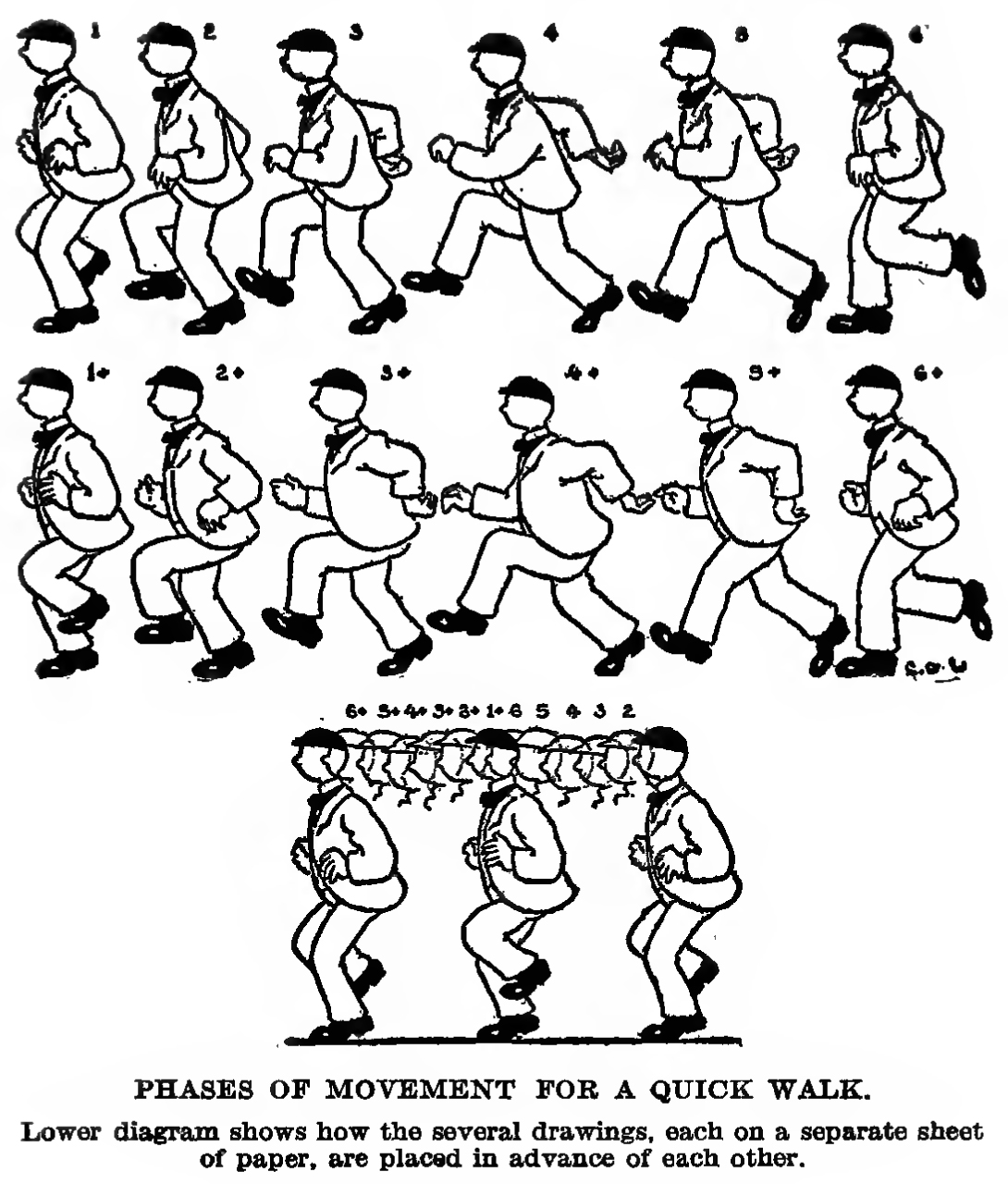
In planning out the positions for a walk, the artist first draws 1 of the extreme outstretched positions (A). (It is causeless that nosotros are cartoon a figure that is going from left to right.) Then on another sail of newspaper the following outstretched position (B), but placed one step in advance. These drawings are at present placed over the tracing glass of the drawing-board. All the post-obit drawings of this walk are to be traced over this glass, and they will be kept in register past the two pegs in the board. Equally now placed, the 2 drawings (A and B) cover the distance of 2 steps. A human foot that is about to fall on the basis and one that is about to exit it come across at a central bespeak. Here a mark is fabricated to indicate a footprint. A like mark for a footprint is made on each side to show the limits of the two steps.
A sheet of paper is next placed over the two drawings (A and B), and on the central footprint the centre position (C) of the legs is drawn. In this the right limb is nearly straight and supporting the body, while the other limb, the left, is bent at the knee joint and has the foot raised to clear the ground. The side by side stage will exist to brand the· first
in-betwixt position (D) between the get-go extreme and the middle position. It is made on a fresh canvass of newspaper placed over those containing the positions just mentioned. The attitude of the correct limb in this new position would exist that in which information technology is about to constitute its pes on the ground and the left limb is depicted as if set up to swing into the position that it has in the middle one (C).
Then with the middle position (C) and the concluding extreme one (B) over the glass, on another canvass of paper, the side by side in-betwixt one (Due east) is drawn. This shows the right human foot leaving the basis and the left leg somewhat forward ready to found its heel on the ground. We take now secured five phases or positions of a walking movement.
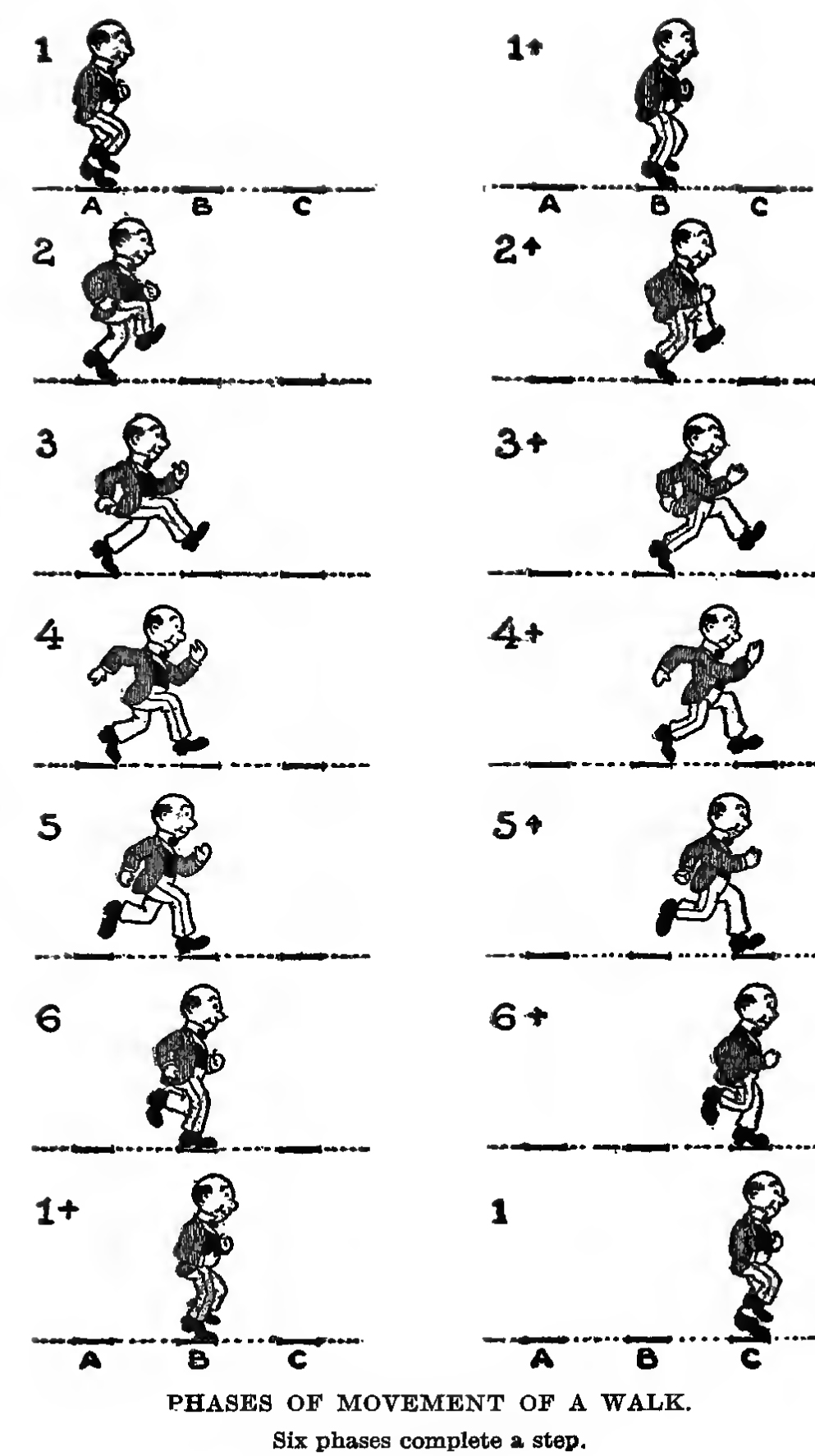
The 2 extremes (A and B) spoken of equally the outstretched ones have the aforementioned contours merely differ in that in i the right limb is forward, and the left is directed obliquely backward, while in the other it is the left limb that projects forwards and the right has an obliquity astern.
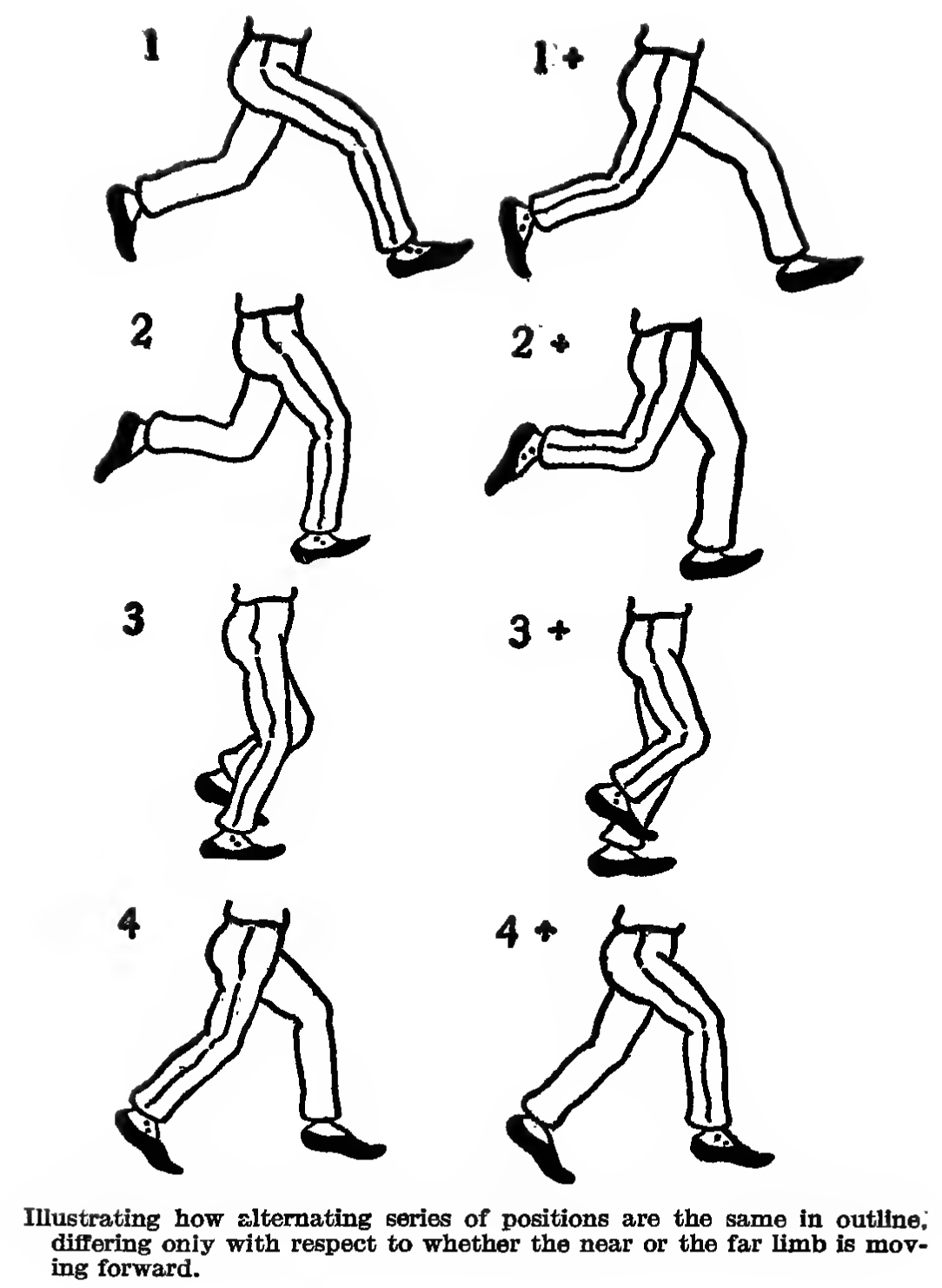
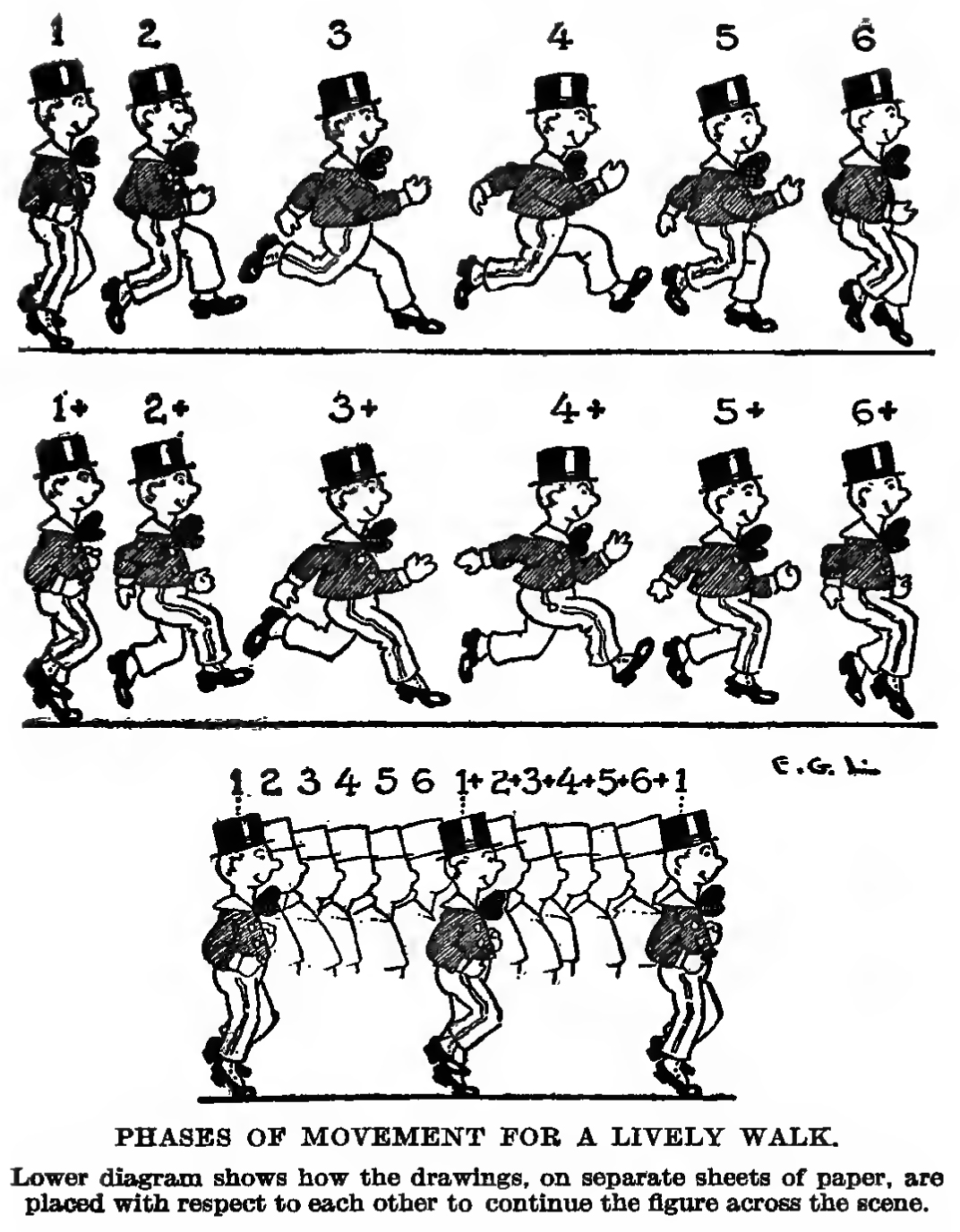
Now, if we make tracings, copying the outlines just, of the three other positions (C, D, and E), but reversing the detail aspects of the correct and the left limbs, we shall take obtained plenty drawings to consummate two steps of a walk. Every bit a better understanding of the preceding the fact should exist grasped that while one limb, the
correct we will say, is bold a sure position during a footstep, in the next step it is the plow of the other limb, the left, to assume this particular position. And again in this second step, the right limb takes the corresponding position that the other limb had in the first footstep. In that location are always, in a walk, two sets of drawings, used alternately. Any particular silhouette in one set has its identical silhouette in the other ready, only the attitudes of the limbs are reversed. To explain by an instance: In the cartoon of ane middle position, the right leg supports the torso and the left is flexed, in its coincidental drawing, information technology is the left that supports the body and the right is flexed. (See 2 and 3+, of the drawing 2 above .. not directly to a higher place, but the one earlier it).
From this it tin be seen that the two sets of drawings differ merely in the details within their full general contours. These details will be such markings equally drapery folds, stripes on trousers, indications of the correct and the left pes by little items like buttons on boots. Heeding and taking the trouble to mark lilliputian details like these add to the
value of a screen image.
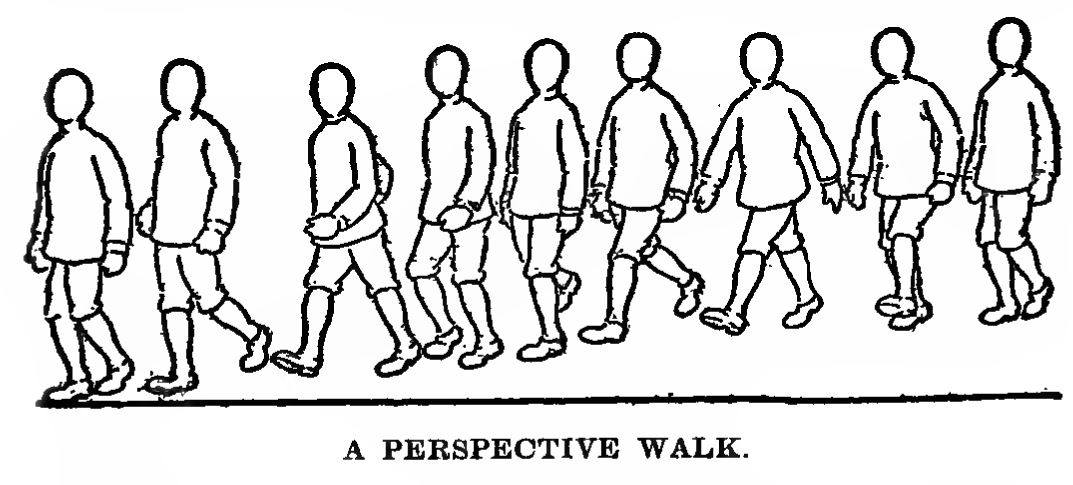
1 of the most difficult actions to depict in this art is that which the animator calls a perspective walk. By this term he means a walk in which the figure is either coming diagonally, more or less, toward the front end of the picture or going abroad from it toward the horizon. Information technology is obvious that according to the rules of perspective,
in coming forward the figure gets larger and larger, and in travelling in the opposite direction it gets smaller and smaller. To do this successfully is non piece of cake. But after a worker has had a bully deal of experience in the art is he able to describe such a motility easily.
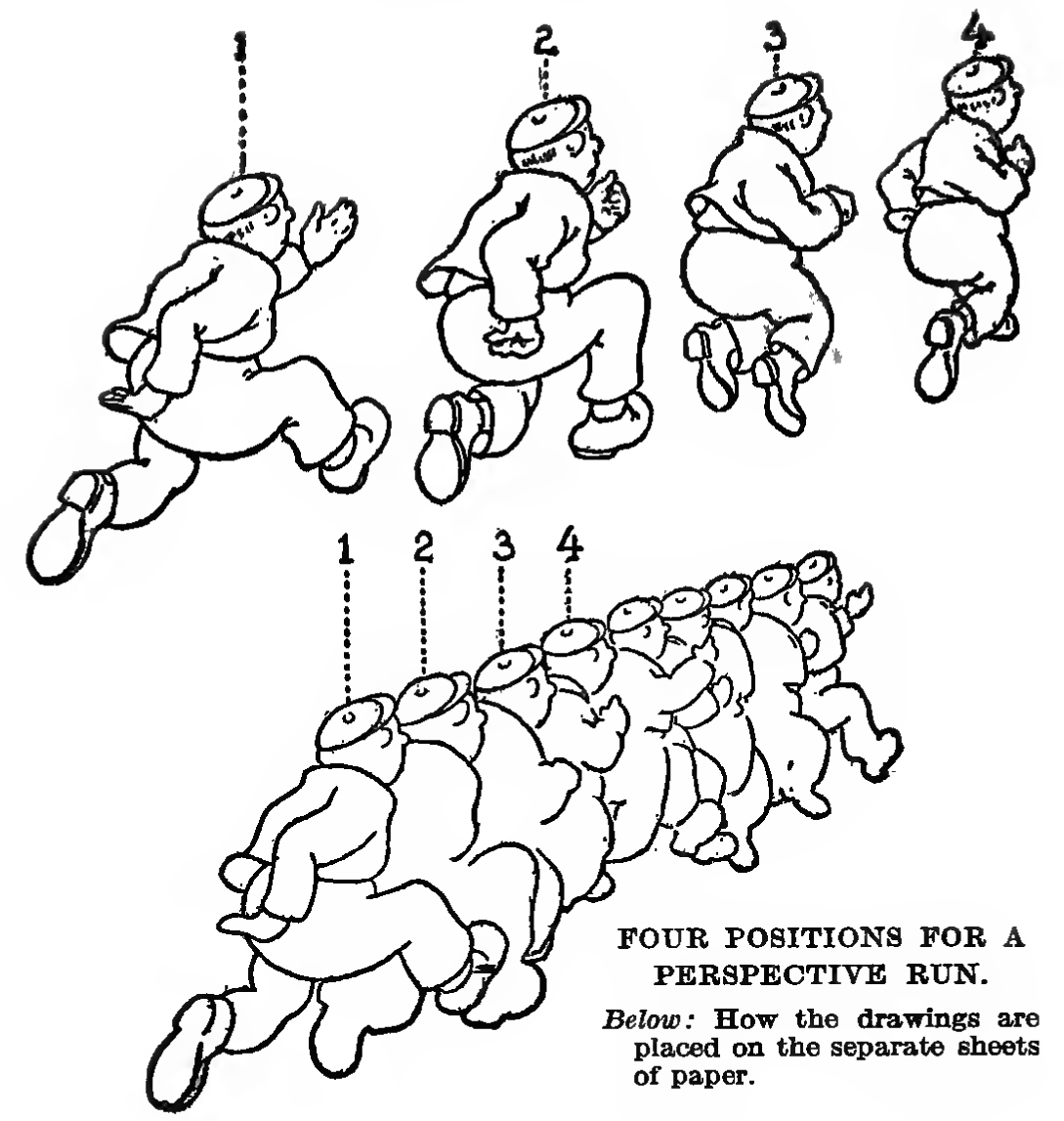
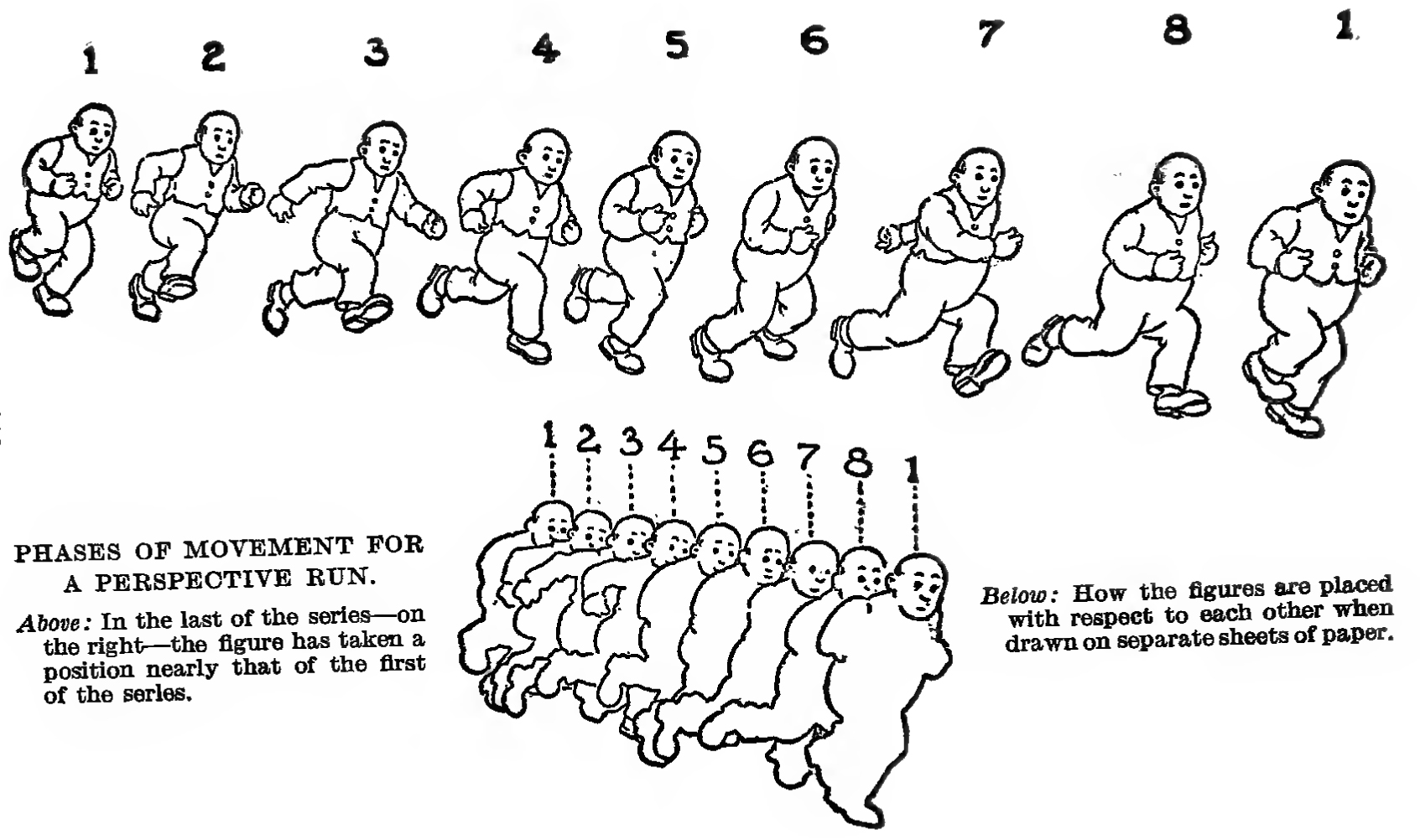
The abiding irresolute sizes of the figures and getting them within the perspective lines in a graduated series are perplexing enough matters. But this is not all. At that place is the trouble of the foreshortened views every bit the limbs are beheld perspectively. Imagine, for case, an arm pointing toward the spectator in a foreshortened view.
Every artist would take his own individual way of cartoon this. Those with a natural feeling for course and understanding anatomy solve problems of this kind by methods for which it is incommunicable to give any recipe. Some would outset with preliminary construction lines that accept the appearance of columnar solids in perspective, while others scribble and bollix around until they find the outlines that they want.
Happily in near of the occasions when a perspective walk is required in a story it is for some humorous incident. This signifies that it can be made into a speedy action, and that merely a few drawings are needed to complete a stride.
Artists when they begin to make drawings for screen pictures find a new interest in studying movement. In the study of art the student gives some attention, of form, to this question of movement. Normally, though, the study is not discriminating, nor thorough. Merely to become skilled in animating involves a thoughtful and analytic
inquiry into the subject. If the artist is a real student of the subject field its consideration volition be more than engrossing than the more or less slight study given to the planning of the unmarried isolated phases, or attitudes, of activeness in ordinary pictorial piece of work.
A groovy aid in comprehending the nature of motility and grasping the character of the attitudes of active figures are the so-chosen "analysis of motility" screen pictures. In these the model, generally a muscular. person going through the motions of some gymnastic or athletic activity, is shown moving very much slower than the
movement is in actuality. This is effected past taking the pictures with a camera then constructed that information technology moves its machinery many times faster than the normal speed.
The animated drawing artist becomes, through the training of his heart to quick observation and the studying of films of the nature immediately noted above, an good in depicting the varied and connected attitudes of figures in activeness. Examples for report on account of the clear-cut definitions of the actions, are the acrobats with
their tumbling and the clowns with their antics.
So in the performances of the jugglers and in the pranks of the knock-about comedians, the animator finds much to spur him on to creative imagery. The pictorial artist for graphic or easel piece of work, in any of these cases, intending to brand an illustration, is content with some representative position that he can grasp visually, or, which is more probable to be the example, the i that is easiest for him to draw. But the animator must take
precipitous and quickly observing eyes and exist able to comprehend and remember the whole series of phases of a move.
A fancy dancer, especially, is a rich study. To follow the dancer with his supple joints bending and so hands and bold unexpected poses of body and limbs, requires attentive eyes and a lively mental· photography. The limbs practise non seem to curve merely at the articulations and there seems to be a most unnatural twisting of arms, lower limbs, and body. Only it is all natural. It simply means that there is co-ordination of movement in all parts of the jointed skeletal frame. This co-ordination-and reciprocal activeness-follows definite laws of motion, and it is the business of the animator to grasp their signification. It is, in the principal, the matter already spoken of to a higher place;
namely, the alternate action of flexion or a closing, and that of extension or an opening.
With these characteristics at that place is also observable in the generality of dancing posturing a tendency of an upper limb to follow a lower limb of the reverse side every bit in the cases of walking and running.

Very strongly is this to be noticed in the nimbleness of an eccentric dancer as he cuts bizarre figures and falls into exaggerated poses. For instance, when a lower limb swings in any item management, the contrary arm oscillates in the aforementioned direction and brings its hand close enough to touch this concurrently swinging lower
limb.
This symbolical phenomenon of the activeness of living things-the negative quality of a endmost or flexion, and the positive one of an opening or extension-is not a feature entirely confined to homo beings and animals, simply is a feature showing in the mechanics of many non-living things.
Technorati Tags: walking, running, how to draw people walking, drawing people walking, how to draw people running, drawing people running, animate walking effigy, animate walking person, animate running effigy


Source: https://www.drawinghowtodraw.com/stepbystepdrawinglessons/2016/05/draw-animate-person-walking-running-huge-guide-tutorial/
Posted by: davidsonfultses.blogspot.com
0 Response to "How To Draw A Person Walking"
Post a Comment